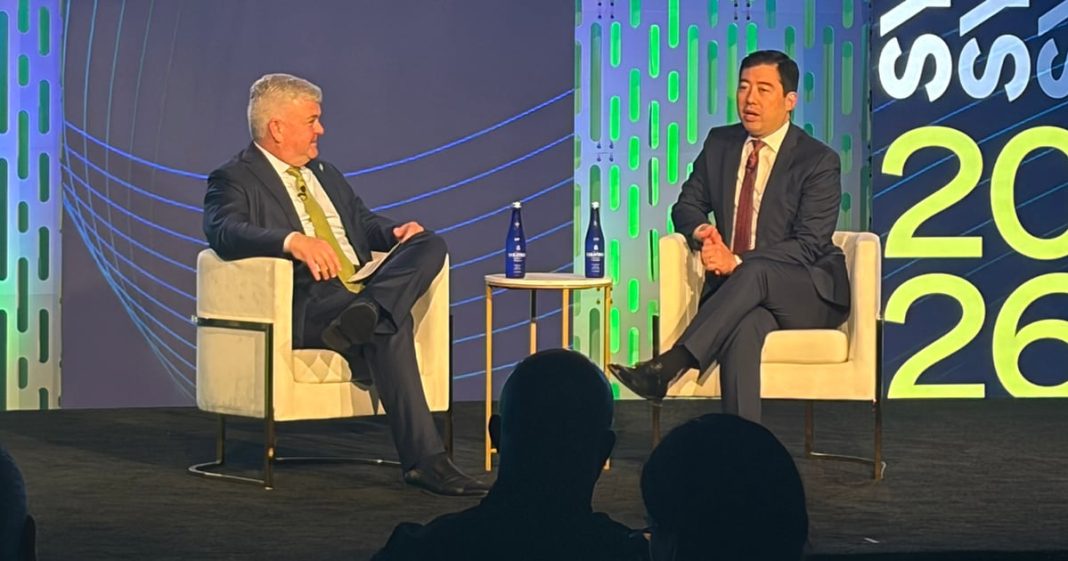

The Securities and Exchange Commission may be down to two commissioners, but Commissioner Mark Uyeda took time this week to encourage registered investment advisors that this version of the SEC trusts their judgment in working with clients over what he called “prescriptive” government regulation.
“The client is trusting you in your professional judgment,” Uyeda said at the Robinhood and TradePMR Synergy26 advisor conference held in Washington, D.C. “What is the risk tolerance? What are the investment objectives? … Are these still the client’s goals and objectives? And then try to find products successfully.”
Uyeda added that government regulators should not dictate the products fiduciaries recommend to clients. He harkened back to the 1980s, when Massachusetts banned retail investors from buying Apple stock, deeming it too risky.
“You can have the most high-risk futures on real property on Mars, but that’s part of the diversified portfolio,” he said. “If it’s just a small part, who is the government to say ‘no, no, that shouldn’t happen—the right amount is zero.’”
Uyeda was distinguishing between SEC-regulated retail clients for advisors and workplace retirement-plan advice that falls under the Department of Labor and the Employee Retirement Income Security Act. The DOL is currently reviewing comments on a proposed rule that would ease the path to alternative investments in 401(k) and other retirement plans.
The former SEC chair under the Biden administration, Gary Gensler, was more outspoken about regulating certain areas of investments, especially cryptocurrency, and led a more active enforcement regime. Current SEC Chairman Paul Atkins has sought to integrate digital assets into markets and the regulatory space, dismissed prior enforcement actions, and reduced the number of SEC investigations overall.
Dan Gallagher, a former SEC commissioner and current chief of legal and compliance for Robinhood, asked Uyeda if he had “any advice” for audience members who were compliance heads or working in compliance for RIAs.
“If you want the essence of fiduciary duty, and perhaps this is how AI would summarize it: basically, don’t lie, cheat or steal from your clients,” Uyeda said. “The CCOs (chief compliance officers) are the frontline staff to oversee that.”
He said regulators have lost sight of that bigger picture and “become too prescriptive” in enforcement in areas such as Rule 206(4)-7, known as the compliance rule, which considers whether firms have set and maintained compliance policies.
“Most important, I look at fiduciary duty as a process,” he said. “That doesn’t mean you get a certain designated output—‘This product’s okay, this product is not.’ Fiduciary duty has a duty of care, you’ve got a duty of loyalty, and a duty of disclosure.”
As of earlier this week, smaller RIAs had to comply with changes to Regulation S-P that expanded firms’ responsibilities for safeguarding customer data. Firms with over $1.5 billion in managed assets had a Dec. 3, 2025, compliance date, while firms below the threshold had to meet this week’s deadline.
Uyeda said the SEC is aware that many RIAs are small and people “wear many hats,” including for compliance. He said regulators who are looking into firms after a negative trigger event will assess whether processes were in place, updated, and followed.
“I’ve constantly questioned our staff: When I see a Rule 206(4)-7 charge, why are we charging this?” he said. “The easiest situations are those in which there was no compliance policy in place … or you can have perfectly reasonable policies and procedures, and there can still be an underlying problem or incident that merits enforcement, but that doesn’t mean those policies were deficient.”
Gallagher agreed with the approach being taken by his former colleague.
“I worried for a while that CCOs were easy targets, especially on the advisor side with the compliance rule … it’s good to know there’s something more rational,” he said.