
As artificial intelligence and other tremors rock the financial services industry, Cresset CEO Susie Cranston speculated that the war for talent may intensify.
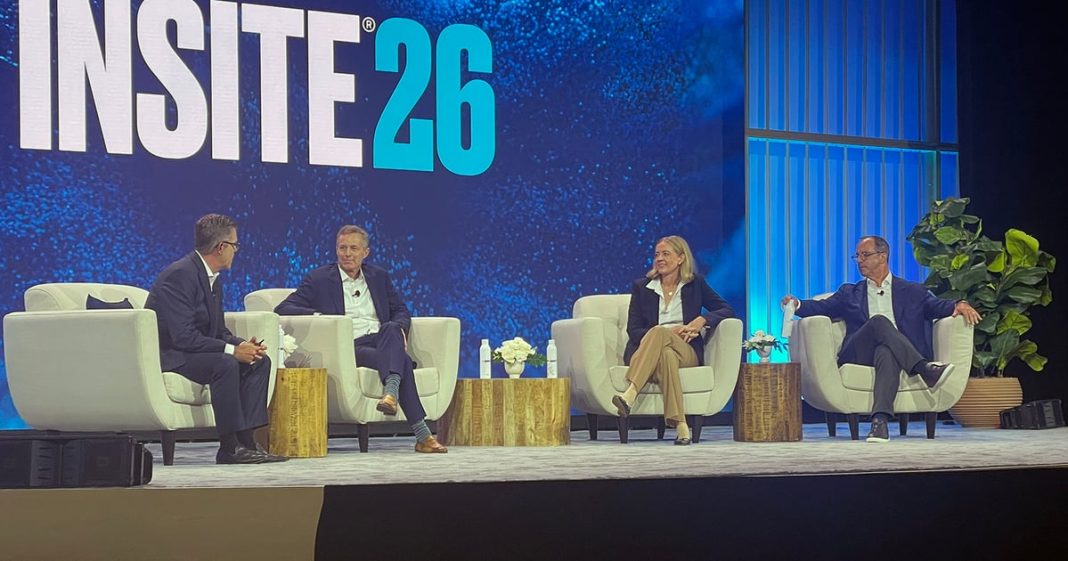
During last week’s BNY INSITE conference in Aurora, Colo., Cranston said that “over time, even with AI,” finding experienced individuals may become more challenging, prompting the firm to develop more talent in-house.
Calling talent “the only insurance policy you have in a highly uncertain world,” Cranston’s framing echoed that of other conference speakers, such as ClientWise CEO Ray Sclafani, who told his audience that AI was “a talent strategy issue, not a tech issue.”
In an interview at the conference, Cranston said if someone attends any CEO gathering lately, they’ll find widespread agreement that the current period includes “the most rapid change that we’ve ever seen,” and finding (and keeping) talent is the best way to safeguard a company for a future that is wholly unpredictable.
However, Cranston stressed that advisors must be willing to experiment with AI, as individuals unwilling to do so will delay firms’ integration of the tools, leading to higher costs and uncompetitive products.
Having AI “fluent” advisors will also help with a client base that’s likely to use such tools in their own dealings with advisors (for example, inputting financial documents to generative AI and asking for takeaways). Cranston said the Cresset team discussed possibilities in which agentic AI develops enough that clients have their own agents retrieving information from reps.
“You can imagine a role where AI agents are going to reach out to advisors and say, ‘Oh, I’m prepping my person for the next day, and I need you to give me all the documents you’re going to go through with my person tomorrow,’” she said. “That’s not an unlikely scenario.”
For Ryan Shanks, the chief growth officer for Apollon Wealth Management, the “character fit” between a rep and a potential new firm remains paramount in the age of AI, telling WealthManagement that if firms and new advisors don’t each have ways to screen the partnership, they could run into difficulties later.
“It’s a chaotic, noisy marketplace. Everybody’s out there trying to do a deal. Everybody’s throwing money at opportunity,” Shanks said. “So the problem that we have is there’s a lot of noise, and it’s very much a gray area that advisors are in to try to evaluate. If I’m being told it’s legit, how can I validate it? You can’t. You have to just say, ‘I’m going to trust this organization and everybody I’m talking to to be forthcoming.”
One aspect of advisor recruiting that Cranston said AI could greatly assist with is transitions between firms. In the past, advisors moving between firms had to repaper, creating a “big logistical shift” for reps and clients alike. Cranston said that with AI, this could become instantaneous.
“The client just says to the AI agent, ‘Yep, give my advisor everything they need at their new firm.’ And so the move might actually get a lot easier,” she said. “The work of the transition might actually not be so much moving the assets, but it might be resetting up all the little things that AI did before.”
In his presentation, Sclafani pinpointed six simultaneous forces shaping “the talent landscape,” including succession pressure, client expectations, advisor mobility, firm size, younger generations’ ascents in the workplace and AI.
Sclafani said about 349,000 advisors changed firms last year, one of the highest rates in a decade, and about one in 10 advisors are expected to change practices in 2026.
That churn, coupled with the fact that firms with over $1 billion in AUM represent only 22% of the market but manage almost 88% of the assets, puts a strain on both potential employers and employees, particularly for firms expecting to scale.
“Do you have the bench strength based upon the expected rate of organic growth and the expected rate of inorganic growth through M&A?” he asked. “Do you have the bench strength in your organization to continue to scale up the rate that you’re going to need, or are you going to run out of that talent?”
According to Sclafani, large RIAs that are continuing to scale are asking those questions now.
“‘Hey, are we able to retain the advisors that we have? What is the culture? What does the nature of the work look like?’” he asked, speculating on those questions. “The nature of the work is changing dramatically. The nature of the workplace matters, and for those in charge, if there’s not a strong relationship and culture, (employees) may choose to vote with their feet.”