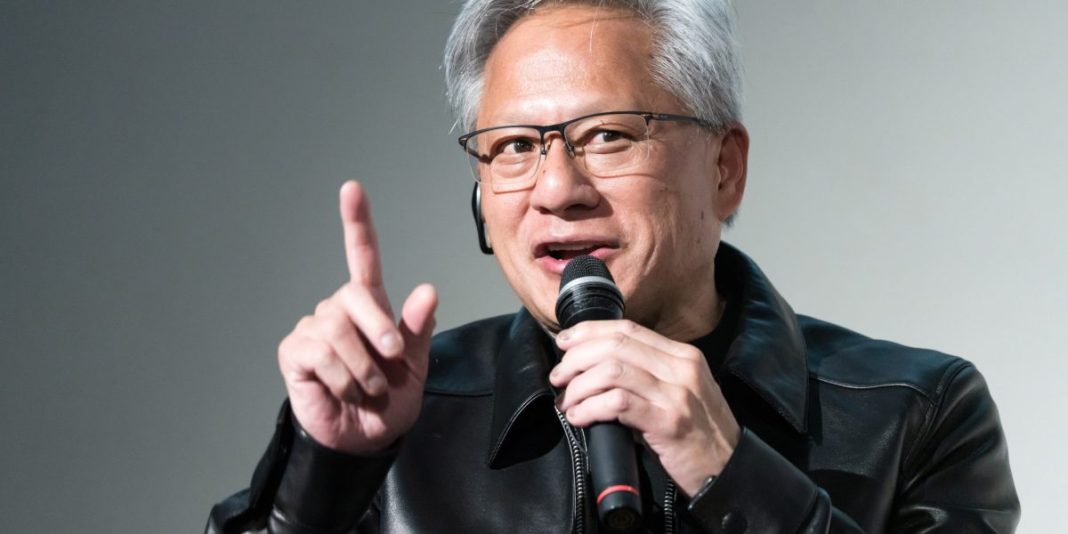

Jensen Huang made his first-ever X post on Friday, sharing an open letter signed by 25 companies including Nvidia, Microsoft and Palantir, warning Washington not to repeat the mistake of over-restricting technology the way some feared for open-source software in the 1980s.
The letter argued instead that open-weight AI models should be preserved as a foundation for American leadership, suggesting that Huang and his ilk genuinely fear that they won’t be.
“Open models strengthen safety and cybersecurity, accelerate innovation and diffusion, and enable sovereignty,” Huang wrote. “The world needs both frontier closed models and frontier open models.”
He drew a direct parallel between today’s fight over open-weight AI and the 1980s open-source software movement, arguing that just as open-source code became foundational to the modern internet despite early skepticism, open AI models must be allowed to flourish rather than face “premature restrictions.”
The letter carries roughly 25 signers, including Microsoft, Meta, Hugging Face, Andreessen Horowitz, Perplexity, and IBM, and makes three central claims: open models expand economic access for startups and universities, they strengthen competition by preventing a few firms from controlling the technology, and they actually improve security by letting more researchers audit code and patch vulnerabilities rather than relying on a small number of closed “single points of failure.”
It also defends distillation — the practice of training one model using another’s outputs — as a legitimate, longstanding research technique that shouldn’t be conflated with theft, even as this remains a live controversy.
“Software developed by the open-source community now supports most of the internet,” the letter argued, and it underlies systems used by the world’s largest technology companies, along with the U.S. military and federal agencies conducting critical missions like scientific research and cybersecurity. Open source did far more than lower the cost of software, the letter continued — it created a “shared foundation of knowledge on which generations of American engineers and entrepreneurs built their institutional sovereignty.”
The post lands as Washington debates whether to restrict Chinese open-weight models like Moonshot AI’s Kimi K3, which was released July 16 and ranks among the most capable models anywhere. White House adviser Michael Kratsios has accused Moonshot of using distillation to copy a U.S. model to build Kimi K3, adding tension to the distillation debate.
A week before Huang’s post, Chinese President Xi Jinping made his debut appearance at the World AI Conference in Shanghai on July 17, delivering a keynote that pointedly claimed the same “openness” mantle for China. He called for “a symphony of global cooperation” rather than “a solo performance by any single country,” and urged the world to “jointly oppose overstretching the national security concept in the field of AI” — read by analysts as a direct jab at U.S. export controls. Xi also stressed a “people-centered” approach and pledged cooperation with Africa, Latin America, Asia, and BRICS nations to prevent “new historical injustices” in AI access, backing this with concrete offers like 5,000 AI training slots for developing countries.
The day before Xi’s speech, 29 countries — including Russia, Pakistan, Indonesia, Brazil, and Kazakhstan — signed an agreement in Shanghai establishing the World Artificial Intelligence Cooperation Organization (WAICO), a Shanghai-headquartered body meant to rival U.S.-led AI governance, with UN Secretary-General António Guterres in attendance. Some analysts questioned whether the tech world was splitting into rival blocs.
The timing creates a genuine problem for the U.S. coalition’s messaging: Xi is now occupying the same “pro-openness, anti-restriction” rhetorical space that Huang’s letter claims for American industry, just from a rival capital. This is compounded by Huang’s own record of praising Chinese models — he previously said “China will win the AI race” and more recently called Chinese open models “excellent” — putting Nvidia’s CEO closer to Beijing’s framing than to the more hawkish stance of OpenAI and Anthropic, both of which are notably absent from the open-weights letter and have warned Washington about the risks of strong Chinese open models.
For this story, Fortune journalists used generative AI as a research tool. An editor verified the accuracy of the information before publishing.