
What happened to mortgage rates this week?
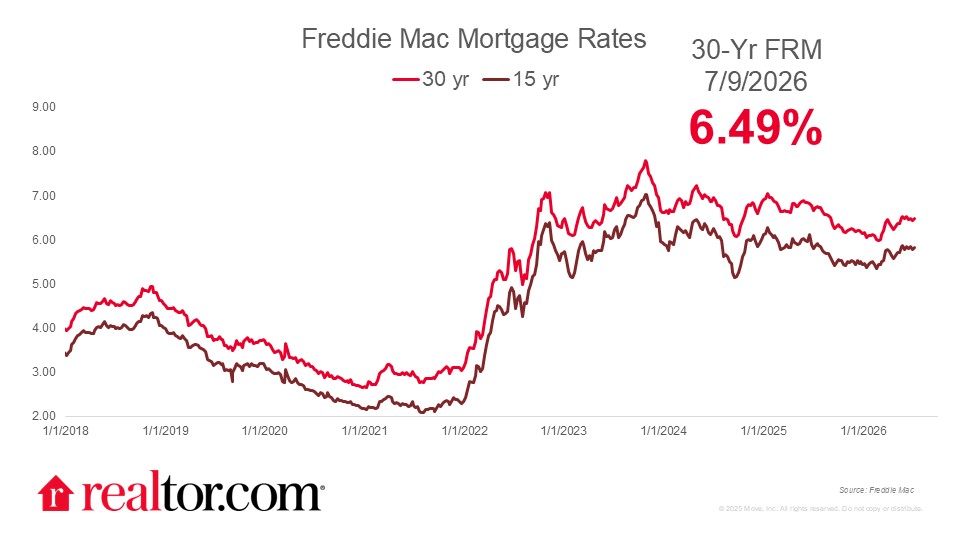
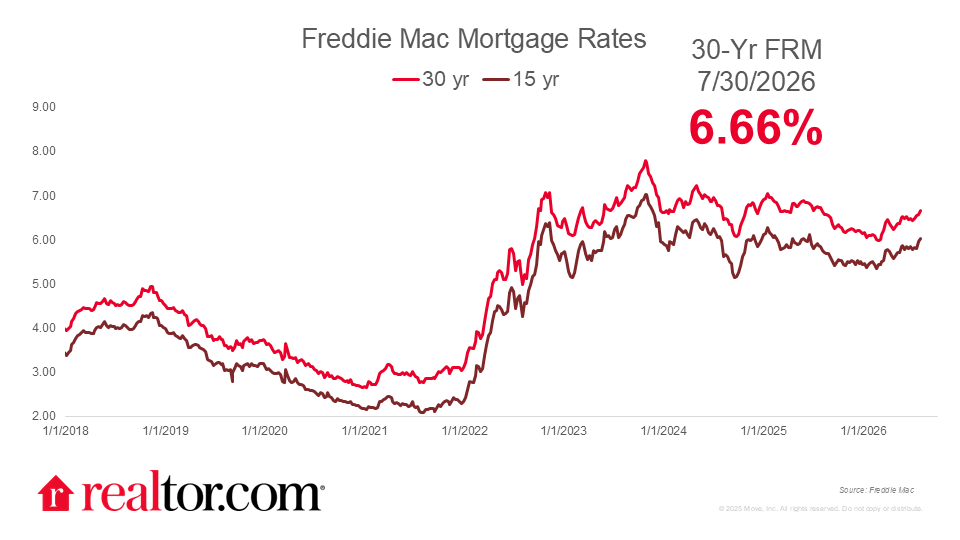
The Freddie Mac 30-year fixed mortgage rate rose 8 basis points this week to 6.66%, up from 6.58%, as renewed conflict in Iran pushed Treasury yields higher. Peace talks that had shown promise in early July have broken down, and markets are again reacting to the uncertainty, along with the inflationary pressure that comes as the conflict lifts oil prices.
The Federal Reserve held the federal funds rate steady this week in a range of 3.5 to 3.75 percent, where it has stood since December. Three members dissented in favor of a 0.25 percentage point hike, a signal that the committee is no longer in lockstep on inflation and that a cut is not the next move on the table. The 10-year Treasury yield jumped as the decision came out, and markets have started pricing in a rate increase as soon as September. Since mortgage rates tend to track the 10-year Treasury, this week’s move higher reflects that repricing. Thursday’s Personal Consumption Expenditures report, the Fed’s preferred inflation gauge, dipped 0.1% in June for its first monthly decline since 2020, but the drop traced back to falling oil prices during June’s brief U.S. and Iran truce, which has since collapsed, making it look more like a backward-looking low point than the start of a durable slowdown.
What does this mean for the housing market?
After the most buyer-friendly spring in years, summer activity has cooled, with pending home sales falling 5.4% in June as rates climbed from below 6.0% in late February to above 6.5% by mid-July. Would-be buyers, especially first-timers who tend to carry larger loans, are the most exposed to each uptick in borrowing costs, while owners holding sub-4% rates have little reason to list and swap into today’s market. That lock-in continues to cap inventory even as the sellers who do list increasingly price to move. With the Fed signaling that its next move is more likely a hike than a cut, near-term rate relief looks unlikely. Because oil remains the primary channel through which the Iran conflict feeds inflation, a de-escalation and a reopening of the Strait of Hormuz remains the clearest path back toward lower rates.