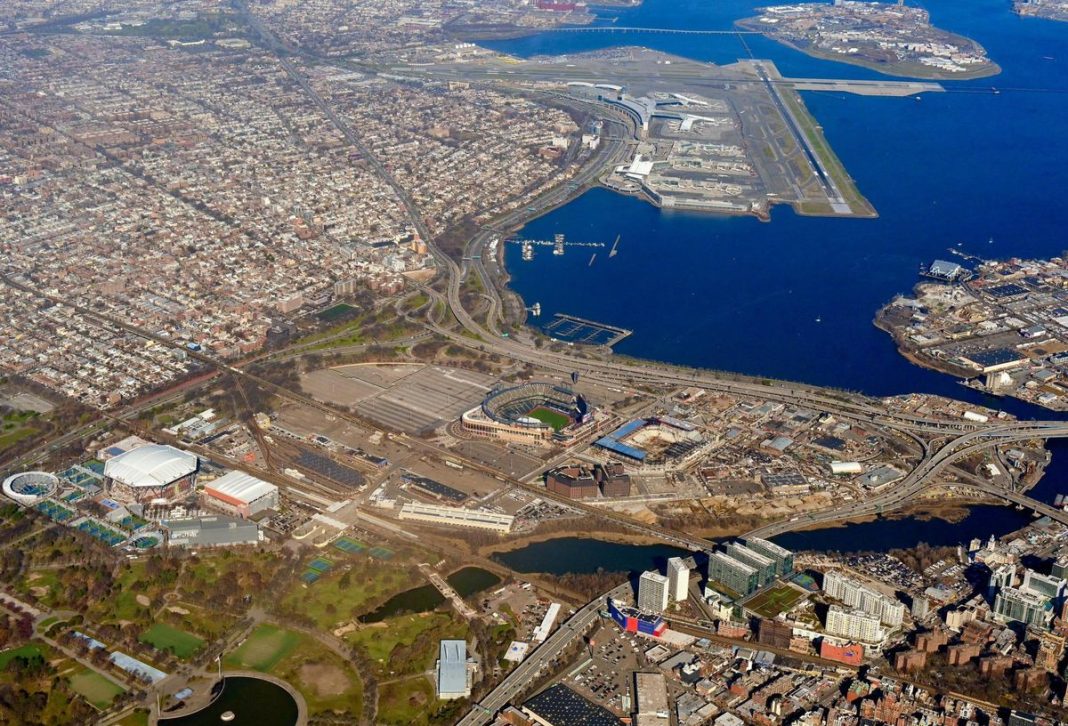

When Cushman & Wakefield brokers Dylan Walsh and Kieran Baker are pounding the pavement in Willets Point, they are hoping their clients can see the northern Queens neighborhood’s potential through the haze of its grungy, industrial present.
In the coming years, investors and developers are expected to pour at least $9B — roughly 30% more than the entire New York Police Department budget — into three projects in the neighborhood that the Mets call home. But none of those commitments have been enough to sell developers on the potential of the nearby land, even as property values have risen in recent years.
“It really is going to come down to who’s going to be the first one to have a private development plant their flag there,” Baker said.
Courtesy of Avison Young
Willets Point, despite being flanked by the populous neighborhoods of Corona and Flushing and next to some of NYC’s highest-profile economic engines, has little private market development.
This month, a partnership between Related Cos. and Sterling Equities, which has received at least $500M in financing so far, cut the ribbon on the first 880 apartments out of 2,500 new affordable homes planned in Willets Point.
The development accompanies the New York City Football Club’s long-awaited $800M soccer stadium, expected to open next summer.
The costliest project of all, Steve Cohen and Hard Rock International’s $8B casino-centered entertainment complex, is preparing to start construction.
“Queens has always had the largest land mass,” Queens Borough President Donovan Richards said. “And with the largest land mass comes a lot of opportunity, because we’ve always historically had a lot of undeveloped land.”
A PropertyScout data analysis provided to Bisnow suggests that owners could capitalize on the neighborhood’s new momentum: Between 2021 and 2025, land prices within a mile of the Willets Point subway stop increased by 51%.
“Now that you see what we’ve developed, you could certainly see that the fuse has been lit,” said Related Executive Vice President Frank Monterisi, who is leading the company’s Willets Point project.
One owner in the neighborhood is trying to cash in: The Fodera family, which has been in the bakery supply business for 80 years, is selling a 138K SF site at 129-02 Willets Point Blvd.
The property could yield up to 332K SF of development, according to an Avison Young marketing brochure shared with Bisnow. James Nelson, one of the brokers representing the family, said his team is soliciting bids “north of $60M.”
“We’ve actually been in discussions with the family ownership for 10 years,” Nelson said. “It was always just a question of when is the right time.”
Economic Engines Not Yet Driving Activity
A century ago, F. Scott Fitzgerald is rumored to have drawn inspiration for The Great Gatsby’s Valley of Ashes from a dump in the neighborhood.
Decades later, Willets Point’s skein of autobody and steelwork shops led to the nickname “The Iron Triangle.” And as recently as 2013, it didn’t even have sidewalks or sewers.
“When modern New York was built, with all the infrastructure and roads and everything, Willets was kind of left behind,” Monterisi said. “It was really like a dumping ground.”
Former mayors have long pushed for changes to help Willets Point grow.
Michael Bloomberg proposed a megamall. Bill de Blasio scrapped that and paved the way for Related and Sterling Equities’ affordable housing developments, which broke ground in December 2023. Eric Adams poured $270M into the neighborhood’s transformation, including cash for crucial sewer infrastructure, and he announced the Etihad Park soccer stadium.

Bisnow/Mark Bonner
Etihad Park, the NYCFC’s stadium, under construction in early June
Willets Point’s western and southern borders are now major NYC economic hubs. The Citi Field baseball stadium and the U.S. Tennis Association’s Billie Jean King National Tennis Center generate millions of dollars in revenue and billions in economic impact. Across the river to the east, Flushing — home to NYC’s largest Chinatown — has experienced a development boom in recent years.
Cohen’s Metropolitan Park casino would become another economic engine on the border of the neighborhood, bringing in an estimated $33.5B in tax revenue. The complex, which pulled off a complicated political maneuver to obtain some of its land, will add 35 acres of green space, a Hard Rock Hotel, a live music venue able to accommodate more than 5,500 people, and 450 units of 100% affordable housing.
“Could I have ever envisioned that the Valley of Ashes would turn into the Valley of Opportunity?” Richards said. “You know, I’m always a hopeful person.”
But even now, neither buyers nor sellers are making moves in Willets Point.
“The businesses that are on this remaining land are all flourishing,” Walsh said. “These owners who own the businesses and the land can continue to operate, and they’re in no rush to sell.”
Development site buyers, meanwhile, would have to be institutional investors or large private players with equally deep pockets, Walsh said.
They would have to time their project’s delivery with the casino’s planned 2030 opening date for new developments to yield appetizing rents. Doing so involves holding on to land through multiple refinancing cycles, adding to the cost that developers would need to pay.
“If you have $40M sitting around and could park your money here and get the land at a pretty cheap basis, then you’d hit a home run,” Baker said. “It’s just tough to park that much capital there.”
Zoning Is Dampening Development Demand
Two sales identified in PropertyScout data may hint at developers and investors dipping their toes in the water in Willets Point.
In October, a company linked to the St. John family netted $20M by selling a gas station on a 0.9-acre lot at 127-48 Northern Blvd., just feet away from a six-lane highway, The Real Deal reported. No plans for that site have yet been filed with the Department of Buildings.

Courtesy of SHoP Architects/Field Operations
A rendering of Steve Cohen and Hard Rock International’s casino proposal
In March, Hiwin Group USA and Sam Chang’s McSam Hotel Group scored a $110M construction loan from Maxim Capital for a site at 131-02 40th Road, just across the Flushing Creek.
The developers are planning an 800-room hotel on the site after buying it for $32M last year and obtaining the special permit required by the city for new hotel construction. The hotel will eventually be triple-branded, with rooms under True by Hilton, Hampton Inn and Suites by Hilton and Stay Home Suites by Hilton flags.
Maxim co-founder and Managing Partner Adam Glick said while he would like more opportunities to lend on Willets Point projects, developer demand isn’t there yet.
“We’ve really been focused on the Flushing side, where our borrowers have taken us,” he said. “It’s definitely early, but I think based on what’s going on on the Willets Point side, there’s going to be a tremendous amount of development over the next few years.”
Additionally, developers eyeing the area may have difficulty identifying projects because of the neighborhood’s haphazard zoning, PropertyScout CEO Wilson Parry said.
“Imagine walking into a dollar store to buy a pair of $1 scissors and finding nine different prices depending on which aisle you’re standing in, what day of the week it is, and whether you’re wearing a blue shirt,” he said by email. “That’s Willets Point zoning.”
Willets Point’s zoning hasn’t been updated since 2008, when the city also capped floor area ratios on those sites unless developers include high levels of affordability. Even the zoning consultants that Cushman & Wakefield’s Walsh and Baker used found them hard to parse, the brokers said.
For now, there is little movement in the neighborhood — even if developers, lenders and brokers believe Willets Point could be fertile ground.
“I have not seen any new opportunities in the immediate area, but we’re open to it,” Glick said. “We just haven’t seen it recently.”