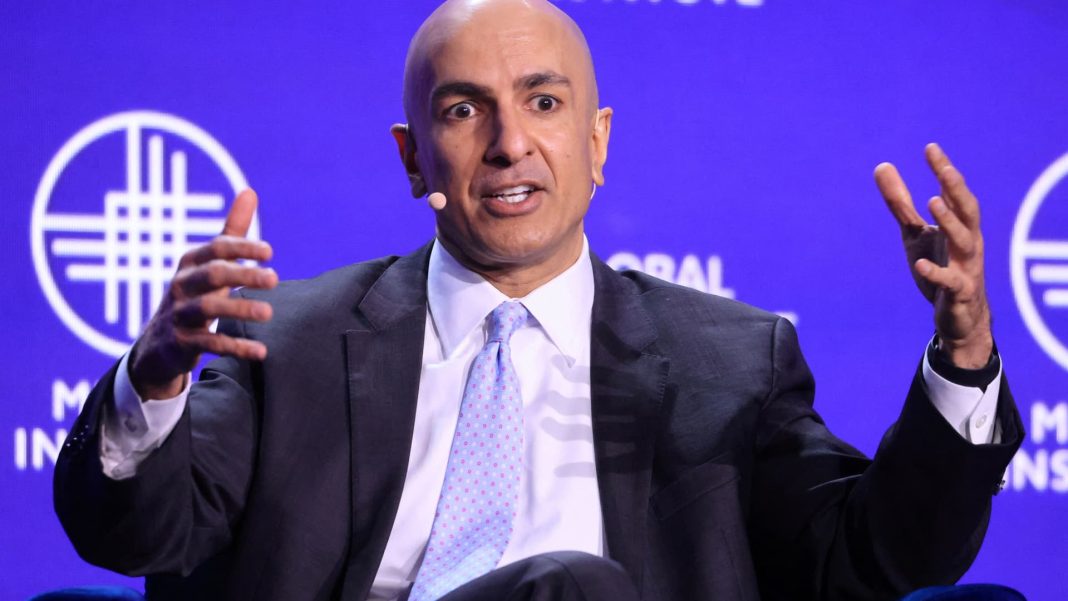

Neel Kashkari, President and CEO, Federal Reserve Bank of Minneapolis, speaks at the Milken Conference 2024 Global Conference Sessions at The Beverly Hilton in Beverly Hills, California, U.S., May 7, 2024.
David Swanson | Reuters
Minneapolis Federal Reserve President Neel Kashkari said Thursday that bringing down inflation in the U.S. remains his top priority, warning that consumer prices are still “much too high.”
Speaking to CNBC’s Kaori Enjoji at the Bank of Japan-IMES Conference, Kashkari said that the U.S. central bank would continue taking a “balanced approach” to its dual mandate of price stability and full employment.
Still, he noted that inflation has remained above the Federal Reserve’s 2% target for more than five years, while the labor market is in “decent shape” right now.
“I am focusing heavily on inflation. I’m not ignoring at all the labor market. We need to pay attention to both sides, but the labor market is in decent shape right now, while inflation is simply much too high,” he said.
Kashkari added that the longer inflation remains elevated, the greater the risk that inflation expectations become unanchored and move higher.
“If that were to happen, then we’d have to respond even more aggressively, so we’re much better off doing what we need to do to keep inflation expectations anchored.”
U.S. headline inflation most recently stood at 3.8% in April. Excluding food and energy, the core CPI increased 0.4% and 2.8%, respectively.
Kashkari said that global inflationary pressures have been fuelled by the Covid-19 pandemic, tariffs, the war in Ukraine, and now, the conflict in Iran.
Asked about the main drivers of the recent inflation surge, Kashkari said there was “some tailwind from what was left over before,” but attributed the current surge to energy and fertilizer prices.
“Those inputs do affect other categories as well, and so one of the things I’m going to be looking for is, when do we see energy prices affecting the broader economy and inflation in the broader economy.”
AI and the Fed
Kashkari was also asked about the impact of artificial intelligence on the Fed’s policy trajectory, and said that if AI really does lead to sustained higher productivity, higher rates could be sustained as the economy is so productive.
However, he also cautioned that the impact is currently hard to judge and, as such, would need to be observed to see how AI translates into sustained higher productivity.
“I talk to businesses all the time, big businesses, especially in America. All tell me that they’re using it, they’re finding useful ways of putting it to work to become more productive, or to give them capabilities they didn’t previously have,” he said.
“I’m bullish on the long-term prospects of AI, but what are the short-term implications for monetary policy, or even the long-term implications? I think it’s still too soon to know.”
New era at the Federal Reserve
The remarks come as the Fed begins a new chapter under Chair Kevin Warsh, who succeeded Jerome Powell.
One of Warsh’s longstanding criticisms of the Fed has been its use of forward guidance, including the so-called “dot plot,” which shows anonymous interest-rate projections from the central bank’s 19 policymakers.
Kashkari, who said he has known Warsh “for a long time,” welcomed a fresh discussion about how the Fed communicates with markets and the public.
When asked for his views on this, Kashkari said that personally, “I don’t love the fact that I have to fill out the dot plot, because the future is so uncertain.”
He said that some suggested solutions include presenting multiple economic scenarios or producing the dot plot only when they are “really trying” to give forward guidance to the market.
“Forward guidance can be a very powerful tool for central bankers. There are few moments when I really want to deliver that guidance,” Kashkari said.
“Most of the time, I’d rather not deliver such guidance, just because the future is uncertain, and so I think this is an example of an area that is ready for a fresh discussion of all of these options.”