
Mammoth Brands wants to take on traditional consumer packaged goods companies, armed with a portfolio of disruptors in the personal and baby care categories that have won over consumers and retailers alike.
For the last decade, upstarts like those owned by Mammoth have challenged the relevance and longstanding dominance of legacy giants like Procter & Gamble, Unilever and Kimberly-Clark. The trend has also played out across packaged food and beverage companies, like Poppi and Olipop taking on Coca-Cola and PepsiCo. Consumers’ loyalty no longer draws on just brand recognition. Newcomers can offer shoppers something different: better prices, higher quality or fewer ingredients that scare them.
“A lot of these companies call these smaller brands ‘ankle biters’ — tells you exactly what you need to know about how they view the threat,” said Nik Modi, co-head of global consumer and retailer research for RBC Capital Markets. “But I think that they’re taking it a lot more seriously. I think it’s gotten to a tipping point.”
With brands like Harry’s razors, Lume Deodorant and Coterie diapers, Mammoth is reshaping the consumer goods landscape, and it has ambitious plans.
“We’re trying to build a leading modern [consumer packaged goods] company, like if Procter & Gamble and Unilever were getting built today,” Mammoth co-founder and co-CEO Andy Katz-Mayfield told CNBC.
In 2024, Mammoth saw revenue of $835 million and almost $100 million in adjusted earnings before interest, taxes, depreciation and amortization, according to a statement from the company. While legacy consumer giants still dwarf the company with their tens of billions of dollars in annual revenue, Mammoth said it has seen a greater than 20% revenue compound annual growth rate over the prior five years through 2024.
Soon, a wider swath of investors could bet on the company’s vision. Mammoth is weighing an initial public offering as soon as the second half of this year, according to a Bloomberg report.
“Today, our private company, we make money, which is great, and we have opportunity to continue to invest in the brands in our portfolio,” said Mammoth’s other co-founder and co-CEO Jeff Raider. “We’ll continue to evaluate the right capital structure for the business over time to enable us to achieve that long-term outcome.”
In the meantime, Mammoth seems focused on challenging existing CPG giants.
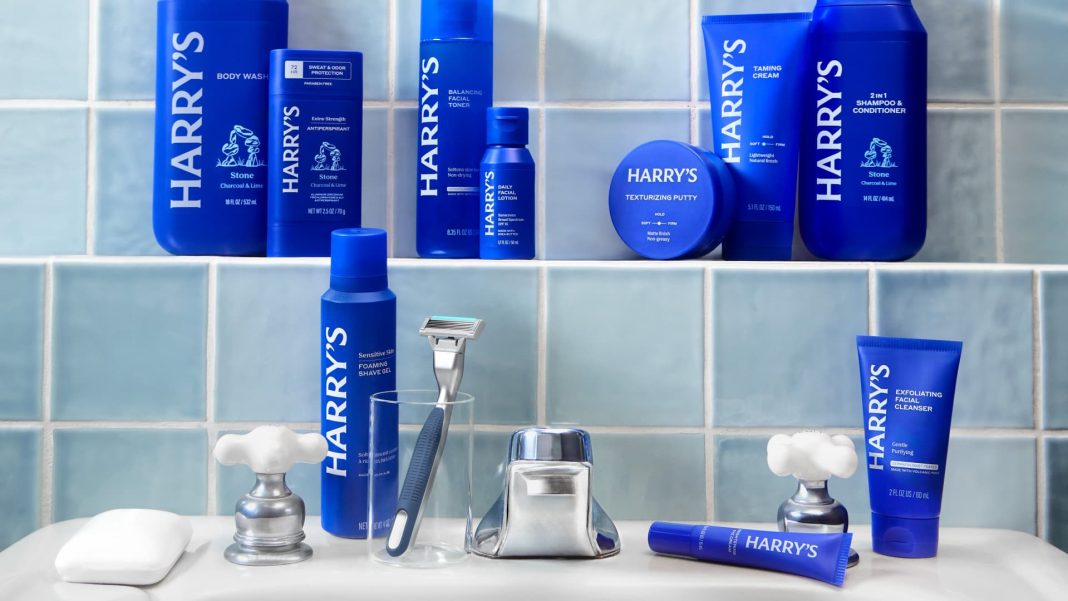
Harry’s began as a razor brand but has expanded into a skincare and men’s personal care.
Source: Mammoth Brands
From start-up to Mammoth
The early seeds of Mammoth began in 2013, when Katz-Mayfield and Raider founded Harry’s. Katz-Mayfield came up with the idea for the startup based on his frustration with the status quo of buying $20 replacement razor blades.
“I called up Jeff,” Katz-Mayfield said. “We decided to build a men’s grooming brand that was a really high quality product at great value, a better overall experience, online led, and I really do think that’s really at the core of everything that guides Mammoth Brands.”
Katz-Mayfield and Raider had previously worked together at Charlesbank Capital Partners and Bain & Company. Before founding Harry’s, Raider co-founded Warby Parker.
Like the glasses startup, Harry’s began online, becoming another disruptor during the era of direct-to-consumer brands. By 2016, it had gained enough customers to land on Target shelves.
Harry’s DTC origins allowed it to tweak its razors and win over customers who were previously loyal to the traditional grooming giants.
Its DTC operating model also helped underscore who the company views as its core customer: the shopper. But traditional CPG companies typically view retailers as their customer, not the person that eventually buys and uses their products.
That perspective influences those companies’ innovation strategies, according to Katz-Mayfield. For example, a CPG company could make a few small tweaks to create a new SKU, or stock keeping unit, to replace an underperforming product SKU, allowing that brand to hold onto its existing shelf space and placate its retail customer, according to Katz-Mayfield.
“It’s not that some of those brands aren’t great and some of those products aren’t great, but … the innovation was driven by a strategy which is, the only way we can grow is to increase prices, and so on,” Katz-Mayfield said. “The only way we can justify price increases is to add bells and whistles that consumers don’t actually want.”
Harry’s made its way to more retailers after Target. The brand stuck to its DTC roots though, insisting on launching new products online first to get feedback from loyal customers.
In 2018, Harry’s launched Flamingo, a women’s shaving and body care brand with the same ethos.
Then the legacy giants came knocking.
In 2019, Schick owner Edgewell Personal Care announced it was buying Harry’s for $1.37 billion. Three years earlier, Unilever had bought Dollar Shave Club, another razor disruptor, for $1 billion. (In 2023, Unilever sold the razor brand to a private equity firm.)
Edgewell offered Harry’s the chance to use its expertise in the direct-to-consumer business model and apply it to the company’s brands, according to Raider. But the Federal Trade Commission sued to block the deal on antitrust grounds, which led Edgewell to walk away from the acquisition.
Still, Katz-Mayfield and Raider held onto their vision of helping other brands achieve success.
“The barriers to starting a brand are lower than they’ve ever been,” Katz-Mayfield said. “Our perspective is that really scaling and maintaining these brands is still really hard.”
Harry’s created an incubator lab, launching cat care brand Cat Person and haircare brand Headquarters. It has since sold Cat Person to Weruva and wound down Headquarters, teaching the Harry’s team the value of staying more focused on what it considers core personal care categories.
Harry’s Labs also invested in the seed round of Hims, but has since sold its minority stake.
“Investing is not really part of the strategy,” Katz-Mayfield said. “We did that at the time as we were testing and learning how we’re going to build the platform. It was a great outcome for us, because [Hims] had a lot of success and the investment was worth a lot.”
In 2021, the company bought Lume Deodorant, which sells sticks, tubes and spray that can be used all over the body. The brand is widely credited with establishing the whole-body deodorant segment. Within two years of the deal, Lume’s sales had more than doubled, according to Mammoth.
The Lume acquisition helped Mammoth learn more about selling on Amazon, where the brand had more experience than Harry’s and Flamingo did, according to Katz-Mayfield.
Building off of the Lume acquisition, Harry’s launched Mando deodorants in late 2022, marketing the same concept to men.
In April 2025, Harry’s Labs officially rebranded as Mammoth Brands. And its next acquisition further demonstrated its desire to be the next big CPG company.
Coterie’s range of premium diapers
Source: Mammoth Brands
Growing with a baby business
In late 2025, Mammoth bought Coterie, a high-end diaper brand founded in 2019 with celebrity investors like Karlie Kloss and Ashley Graham.
The deal was reportedly valued at over $1 billion and involved a mix of cash and stock. Mammoth said in October that Coterie surpassed $200 million in net revenue over the previous 12 months, a nearly 60% jump from the prior-year period.
Coterie’s premium diapers can cost as much as $1 per unit, a steep price for some parents. But the brand has found many consumers are willing to pay more for the product, which promises high absorbency without added fragrance, latex, rubber, parabens, pesticides or chlorine bleaching. Coterie has been “very profitable” over the last three years, according to the brand’s CEO Jess Jacobs.
“Seventy-four percent of parents are willing to pay more for better-for-you products,” she told CNBC. “Parents are looking for better and deserve better, and they’re questioning the status quo, just like we are as a brand and as a company.”
Forty-three percent of the brand’s new customers come from word of mouth alone, according to Coterie.
Under Mammoth, Coterie now has the advantages of being a part of a bigger company; it can learn from e-commerce strategies for Amazon that currently work for Mammoth’s brands. As Coterie broadens its retail exposure beyond higher-end grocers like Whole Foods and Erewhon, Mammoth can introduce it to more retailers. And diapers are complicated to manufacture, so Mammoth can help support that process as Coterie continues to create innovate on its diapers.
For example, Coterie is currently in talks to add more retail partners. And Mammoth sees bigger potential for the brand, too.
“Coterie is a brand that can really extend across baby care,” Katz-Mayfield said. “It’s not just a diaper brand.”
But Coterie’s success has caught the attention of legacy players, who are eager to adapt some of the upstart’s playbook.
Threat to legacy players
For decades, a handful of companies have dominated the household goods and family and personal care categories. Their portfolios are chock-full of iconic brands used every day by Americans, and their histories often stretch back more than a century.
In 1837, soap maker James Gamble and candlemaker William Procter became business partners, creating the company that still carries their names today.
Originally founded as a paper mill company in 1872, Kimberly-Clark now owns a host of brands like Kleenex, Huggies and Cottonelle. It went public nearly a century ago.
In 1930, a merger between a Dutch margarine producer and a British soap maker gave birth to Unilever.
While those massive companies competed with each other, it was nearly impossible for a newcomer to gain a foothold in their well-established categories. For a nascent company, launching a new product was pricey and difficult, as legacy brands held onto their shelf space with a death grip and retailers were reluctant to take a chance.
But over the last decade, these consumer giants have faced a new threat from upstarts.
“We are really seeing competition in CPG has fundamentally intensified, and it’s coming everywhere,” said Sally Lyons Wyatt, chief advisor for Circana’s consumer goods and foodservice insights division. “Small manufacturers are gaining share. Digital and social platforms are lowering the barrier for entry for a lot of these smaller brands.”
The rise of e-commerce meant launching a new consumer packaged good was not the daunting task it used to be. A successful direct-to-consumer business often leads retailers to come knocking on the newcomers’ doors.
“The big retailers have also made the case that they want these culturally relevant brands in their stores to bring in consumers,” RBC Capital Markets’ Modi said.
And social media has also transformed how consumers think about what products to buy.
“Cultural relevance is now equal to or superseded brand equity,” Modi said. “If you think about it, most of the big brands are not losing share to other big brands. They’re losing share to the smaller disruptive brands.”
Look no further than diapers, a $5.43 billion market in the U.S., according to Euromonitor International data.
In Procter & Gamble’s fiscal second quarter, which ended in December, its U.S. diaper volume shrank 2%. Its Pampers had fallen to second place in U.S. diaper sales, trailing Kimberly-Clark’s Huggies for the first time since 2021, according to Euromonitor data.
“I don’t want to gloss over the fact that we have work to do to recover share,” P&G CFO Andre Schulten told analysts on the company’s earnings conference call in January.
While Coterie is growing fast, it remains a much smaller diaper brand than Huggies and Pampers. Still, it looks like P&G has taken note of its success.
P&G had challenged Coterie’s claim that its diapers were up to four times more absorbent than leading brands. A year ago, the Better Business Bureau’s National Programs’ National Advertising Division recommended that Coterie stop using the claim, which the diaper brand followed.
In March, P&G launched Pampers Amore, a line of premium diapers that it touts as “microbiome compatible” and “hypoallergenic.” Most tellingly, the line’s own packaging directly pits it against Coterie; it claims that its liner keeps babies three times drier than Coterie.
“The reality is, they are chasing something that is already gone,” Coterie’s Jacobs said. “We carved out that premium category, we’ve grown it. It’s growing 20% since 2020 and 10% year over year. And they’re late. So it’s a question of, can they move faster? Can they be more nimble, and can they get ahead? And the reality is, at this point, and certainly in diaper, it does not seem like they can.”
Jacobs estimates that Coterie is roughly 18 months ahead of legacy diaper brands.
But CPG giants still have some advantages, according to Modi. For example, the war with Iran is complicating supply chains for key components like packaging materials. While still a headache for legacy brands, they are able to navigate the challenge more nimbly thanks to their size and bargaining power.
And then there is innovation. Modi said that he thinks that big brands still have better research and development teams, which should help them create the best product possible.
And Kimberly-Clark’s exposure to the very competitive Asian diaper market is fueling its innovation, CEO Michael Hsu said that Barclays Americas Select Conference in May.
“We’re going to go through these trial cycles where people are going to try these new things, and they’re like ‘Yeah, maybe I don’t like this as much,'” Modi said. “And they start switching back to some of the bigger brands where the products actually work.”
Rather than trying to beat them, some legacy players have decided to join the upstarts instead. Procter & Gamble bought Native deodorant for $100 million and turned it into one of the company’s dozens of billion dollar brands, by Modi’s estimate. Unilever has snapped up a number of challenger brands, like Gruns, the DTC supplement gummy brand, and Squatch, which sells personal care products aimed at men.
But those deals aren’t always a success for the buyer — or the seller. Sometimes their corporate cultures don’t mesh, or the new owner does not know how to incubate a smaller brand, according to Modi.
For many legacy players, Modi thinks that the best strategy is to create new brands, rather than trying to bring existing lines up to speed.
“It’s about how quickly they can move and how willing they are to be patient and develop a brand,” Modi said, adding that many companies lack the willingness to wait for a small brand to grow into one worth $1 billion.
Becoming a giant?
For its part, Mammoth is trying to prove itself as the kind of company with the ability to help upstarts become personal care powerhouses.
“We would rather have a small portfolio of large brands than a large portfolio of small brands,” Katz-Mayfield said.
Going forward, he and Raider want to add more brands in what they call the “everyday care and wellness” categories. They are looking to add more products to their portfolio that are in “consumable consumer categories,” barring human food and beverages.
“We’re really dogmatic about some of these things that we would never do M&A just to do M&A and buy scale and growth, because we’re not trying to flip these things. We’re trying to own them forever,” Katz-Mayfield said.
Unlike traditional consumer goods companies, Mammoth is less focused on entering specific categories to complement its overall portfolio and instead more interested in customer retention and its growth prospects across e-commerce and brick-and-mortar retail, according to Katz-Mayfield.
“We have to believe that something is online-led but has big omnichannel potential,” he said. “It can be a big $200, $300 million-plus brand because that’s where we’re going to add the most value, helping those brands scale on that journey.”
Mammoth has a team that tracks new brands, starting when they begin to gain traction on social media or Amazon. But every potential acquisition is likely also getting attention from legacy CPG companies or venture capital and private equity firms.
To founders, Mammoth gives its pitch as an owner that offers independence and autonomy, with the infrastructure and corporate support that can introduce upstarts to big retailers like Target. Mammoth also wants the founders and executive teams to stay on for a while.
“We kind of view ourselves as a little of a Goldilocks,” Katz-Mayfield said.
And a new acquisition is likely coming to Mammoth sooner rather than later. The company is primarily focused on growing its portfolio through dealmaking, according to Katz-Mayfield.
“For us, I think like one or two deals a year is probably the right pace,” he said, adding that he believes that Mammoth will have portfolio of eight to 10 brands within the next three or four years.
For all the focus on M&A, innovation hasn’t stopped at Mammoth’s existing brands. For example, Harry’s has been expanding its range of skincare for men.
“The way we think about it, these brands are still pretty early in their journey,” Katz-Mayfield said. “They all have tremendous potential.”
Mammoth still launches new products online first, demonstrating the company’s continued belief in the DTC business model, despite rumors of its demise. About half of Mammoth’s revenue still comes from online sales, according to the company.
“I think DTC is the single greatest place on the planet to build products and brands,” Raider said.
But the buzziest news for Mammoth will likely be its initial public offering, although the co-CEOs played coy about those potential plans.
“Don’t know where that came from,” Katz-Mayfield said when asked about the Bloomberg report about a potential IPO as soon as this year that identified four banks reportedly working on the deal.
“We’re fortunate that we make money as a company, and we’re able to use some of that cash flow,” he added. “We’ve always been sort of more agnostic to what the structure is, but we certainly want a set up that allows us to have access to capital, whether that’s privately or publicly, at some point in the future to pursue that strategy.”