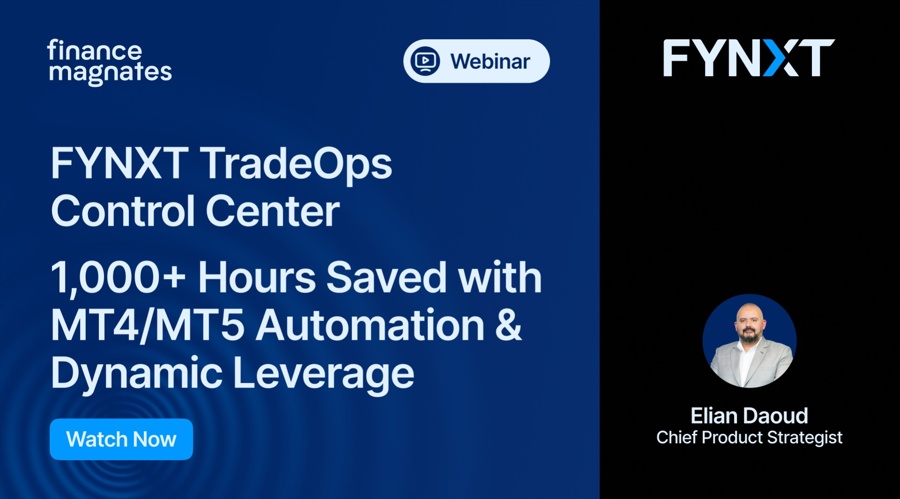

“Your MetaTrader Manager was built in 2007, but your operations team is working in 2027,” says Elian Daoud, the Chief Product Strategist at FYNXT, during a Finance Magnates webinar.
Drawing from a fifteen-year tenure within the FX landscape, he maintains that the industry is confronting a profound technological imbalance. This discrepancy, Daoud suggests, jeopardises the operational agility of even the industry’s most prominent players.
This reality prompted the creation of the FYNXT TradeOps Control Center, a full automation solution for both MT4 and MT5, engineered specifically to eliminate this two-decade technological disparity.
While MT5 is a technological leap forward, a significant segment of the market remains anchored to its predecessor. For the broker, transitioning from legacy infrastructure is rarely a unilateral choice; it is a mandate driven by client loyalty.
So, the back office is effectively trapped in technology built for a world that no longer exists, forcing teams to perform manual, repetitive tasks that invite human error and lead to operational burnout.
Built from the Trenches
For Daoud, developing the TradeOps Control Center has been a deeply personal exercise. Before moving into product development with FYNXT, he spent years in the middle office and operations, experiencing the frustrations of manual brokerage management first hand.
He understands the psychological and physical toll of maintaining legacy systems during peak market volatility.
“I was the one sitting at the terminal at 2:00 AM fixing bad batches, reconciliations, and bulk updates,” he recalls.
This is the work, then, of professionals who have lived through the operational grind.
The resulting suite is modular, allowing brokers to address specific pain points such as risk management or payment processing before expanding into the full range of automation tools. This flexibility ensures that a brokerage can modernise at its own pace without disrupting existing workflows.
The Six Pillars of Operational Excellence
The TradeOps Control Center rests on six pillars categorised into two primary objectives: safety and speed.
Safety features include comprehensive risk management, compliance protocols and a rigorous audit trail for every action taken within the system. Speed features focus on high-level automation and advanced operations that remove the need for manual intervention.
Daoud describes several real-world scenarios where this automation is critical for survival in the modern market.
In the area of incident management, if a bad price feed or an incorrect fill occurs mid-session, the platform allows for the bulk closing of trades and balance adjustments in minutes. This prevents small technical glitches from snowballing into major financial losses.
For finance teams, the system manages high-volume deposits and withdrawals with built-in fraud and duplicate prevention.
Furthermore, the platform simplifies holiday scheduling. Brokers can adjust trading sessions across multiple servers simultaneously, with the system automatically reverting those changes once the holiday period ends.
This removes the risk of an employee forgetting to manually restart sessions after a market break.
Dynamic Leverage and the Power of Hierarchy
One of the most sophisticated elements of the suite is the Dynamic Leverage tool. Daoud notes that most brokers currently rely on static leverage, which creates significant risk during high-volatility periods or thin-liquidity windows. Those who attempt to manage leverage dynamically often do so across disparate, unconnected systems, a process that is notoriously slow and prone to mistakes.
FYNXT’s TradeOps Control Center relies on a clear hierarchy of control. Rules are set at three distinct levels: individual login, group and symbol. Under this system, a rule applied to a single login overrides the group, which in turn overrides the symbol. This provides brokers with granular control, enabling them to protect the overall book whilst offering bespoke conditions to VIP traders without altering the entire infrastructure.
The most significant differentiator is the scheduling capability. Operations teams no longer need to be physically present to adjust leverage for major economic events such as Non Farm Payroll (NFP) releases.
Rules are set in advance and applied automatically, allowing the marketing and client service teams to notify traders of upcoming changes well ahead of time.
This transparency, Daoud highlights, helps build trust, as clients are not blindsided by sudden margin calls or unexpected changes in their trading power.
A New Standard for Swap Management
The Swap Free Tool is another area where Daoud believes FYNXT has set a new industry benchmark. He argues that the traditional approach to swap-free accounts is far too binary for the modern trading environment.
“This is the one that I’m actually really proud of, because when most people hear swap free tool, they think it’s a simple on-and-off switch, zero swaps or default swaps. That’s not actually what we’ve built,” he stresses.
The platform combines two parameters: the number of days between charges and a rate multiplier. This flexibility allows brokers to create complex, competitive pricing models, such as offering a VIP client a half rate or making specific symbols swap free for a limited promotional window.
The engine also integrates directly with CRMs. This allows for automated rule application based on a client’s country of residence or their Introducing Broker (IB) ID. If an IB is reassigned, the rules follow the account automatically, ensuring consistent pricing without manual updates.
“So, put the picture together: three-tier hierarchy, full pricing, flexibility, scheduling, CRM integration on top; that’s not a swap free toggle, that’s a compliance engine,” he says.
Security, Governance and Archiving
Beyond trading conditions, the TradeOps Control Center addresses administrative security and governance. The Manager Creator tool manages the internal staff accounts that access MT4 and MT5. It automates the creation of these accounts using specific naming conventions and whitelisted IPs.
Crucially, it also automates the offboarding process. When an employee leaves the company, their access is revoked according to a pre-set schedule, removing a common security vulnerability that often plagues larger organisations.
The Accounts Archiver addresses a specific pain point for MT5 users. While MT4 has built in archiving policies, MT5 requires a more manual approach. Archiving tens of thousands of accounts with millions of orders can easily crash a server if not handled correctly. To prevent this, the FYNXT TradeOps Control Center splits the archiving process into manageable batches, ensuring server stability and continuous operation even during massive data cleanups.
The AI Frontier
While the current platform focuses on robust automation, Daoud reveals that the company is already looking toward the next stage of development.
“Phase 2 will focus on AI,” he notes.
The next phase aims to introduce an AI assistant capable of answering complex questions based on user guides and technical manuals. The AI will eventually assist in generating and validating CSV files and providing intelligent summaries for reconciliations.
However, Daoud remains cautious about granting full autonomy to artificial intelligence in a high-stakes trading environment. He explains that because they are dealing with legacy infrastructure, the AI will act as an “upper layer” to provide insights rather than taking control of the entire execution process.
The goal is to ensure the technology is 100% bulletproof before increasing the level of AI intervention in critical back-office functions.
“Your MetaTrader Manager was built in 2007, but your operations team is working in 2027,” says Elian Daoud, the Chief Product Strategist at FYNXT, during a Finance Magnates webinar.
Drawing from a fifteen-year tenure within the FX landscape, he maintains that the industry is confronting a profound technological imbalance. This discrepancy, Daoud suggests, jeopardises the operational agility of even the industry’s most prominent players.
This reality prompted the creation of the FYNXT TradeOps Control Center, a full automation solution for both MT4 and MT5, engineered specifically to eliminate this two-decade technological disparity.
While MT5 is a technological leap forward, a significant segment of the market remains anchored to its predecessor. For the broker, transitioning from legacy infrastructure is rarely a unilateral choice; it is a mandate driven by client loyalty.
So, the back office is effectively trapped in technology built for a world that no longer exists, forcing teams to perform manual, repetitive tasks that invite human error and lead to operational burnout.
Built from the Trenches
For Daoud, developing the TradeOps Control Center has been a deeply personal exercise. Before moving into product development with FYNXT, he spent years in the middle office and operations, experiencing the frustrations of manual brokerage management first hand.
He understands the psychological and physical toll of maintaining legacy systems during peak market volatility.
“I was the one sitting at the terminal at 2:00 AM fixing bad batches, reconciliations, and bulk updates,” he recalls.
This is the work, then, of professionals who have lived through the operational grind.
The resulting suite is modular, allowing brokers to address specific pain points such as risk management or payment processing before expanding into the full range of automation tools. This flexibility ensures that a brokerage can modernise at its own pace without disrupting existing workflows.
The Six Pillars of Operational Excellence
The TradeOps Control Center rests on six pillars categorised into two primary objectives: safety and speed.
Safety features include comprehensive risk management, compliance protocols and a rigorous audit trail for every action taken within the system. Speed features focus on high-level automation and advanced operations that remove the need for manual intervention.
Daoud describes several real-world scenarios where this automation is critical for survival in the modern market.
In the area of incident management, if a bad price feed or an incorrect fill occurs mid-session, the platform allows for the bulk closing of trades and balance adjustments in minutes. This prevents small technical glitches from snowballing into major financial losses.
For finance teams, the system manages high-volume deposits and withdrawals with built-in fraud and duplicate prevention.
Furthermore, the platform simplifies holiday scheduling. Brokers can adjust trading sessions across multiple servers simultaneously, with the system automatically reverting those changes once the holiday period ends.
This removes the risk of an employee forgetting to manually restart sessions after a market break.
Dynamic Leverage and the Power of Hierarchy
One of the most sophisticated elements of the suite is the Dynamic Leverage tool. Daoud notes that most brokers currently rely on static leverage, which creates significant risk during high-volatility periods or thin-liquidity windows. Those who attempt to manage leverage dynamically often do so across disparate, unconnected systems, a process that is notoriously slow and prone to mistakes.
FYNXT’s TradeOps Control Center relies on a clear hierarchy of control. Rules are set at three distinct levels: individual login, group and symbol. Under this system, a rule applied to a single login overrides the group, which in turn overrides the symbol. This provides brokers with granular control, enabling them to protect the overall book whilst offering bespoke conditions to VIP traders without altering the entire infrastructure.
The most significant differentiator is the scheduling capability. Operations teams no longer need to be physically present to adjust leverage for major economic events such as Non Farm Payroll (NFP) releases.
Rules are set in advance and applied automatically, allowing the marketing and client service teams to notify traders of upcoming changes well ahead of time.
This transparency, Daoud highlights, helps build trust, as clients are not blindsided by sudden margin calls or unexpected changes in their trading power.
A New Standard for Swap Management
The Swap Free Tool is another area where Daoud believes FYNXT has set a new industry benchmark. He argues that the traditional approach to swap-free accounts is far too binary for the modern trading environment.
“This is the one that I’m actually really proud of, because when most people hear swap free tool, they think it’s a simple on-and-off switch, zero swaps or default swaps. That’s not actually what we’ve built,” he stresses.
The platform combines two parameters: the number of days between charges and a rate multiplier. This flexibility allows brokers to create complex, competitive pricing models, such as offering a VIP client a half rate or making specific symbols swap free for a limited promotional window.
The engine also integrates directly with CRMs. This allows for automated rule application based on a client’s country of residence or their Introducing Broker (IB) ID. If an IB is reassigned, the rules follow the account automatically, ensuring consistent pricing without manual updates.
“So, put the picture together: three-tier hierarchy, full pricing, flexibility, scheduling, CRM integration on top; that’s not a swap free toggle, that’s a compliance engine,” he says.
Security, Governance and Archiving
Beyond trading conditions, the TradeOps Control Center addresses administrative security and governance. The Manager Creator tool manages the internal staff accounts that access MT4 and MT5. It automates the creation of these accounts using specific naming conventions and whitelisted IPs.
Crucially, it also automates the offboarding process. When an employee leaves the company, their access is revoked according to a pre-set schedule, removing a common security vulnerability that often plagues larger organisations.
The Accounts Archiver addresses a specific pain point for MT5 users. While MT4 has built in archiving policies, MT5 requires a more manual approach. Archiving tens of thousands of accounts with millions of orders can easily crash a server if not handled correctly. To prevent this, the FYNXT TradeOps Control Center splits the archiving process into manageable batches, ensuring server stability and continuous operation even during massive data cleanups.
The AI Frontier
While the current platform focuses on robust automation, Daoud reveals that the company is already looking toward the next stage of development.
“Phase 2 will focus on AI,” he notes.
The next phase aims to introduce an AI assistant capable of answering complex questions based on user guides and technical manuals. The AI will eventually assist in generating and validating CSV files and providing intelligent summaries for reconciliations.
However, Daoud remains cautious about granting full autonomy to artificial intelligence in a high-stakes trading environment. He explains that because they are dealing with legacy infrastructure, the AI will act as an “upper layer” to provide insights rather than taking control of the entire execution process.
The goal is to ensure the technology is 100% bulletproof before increasing the level of AI intervention in critical back-office functions.