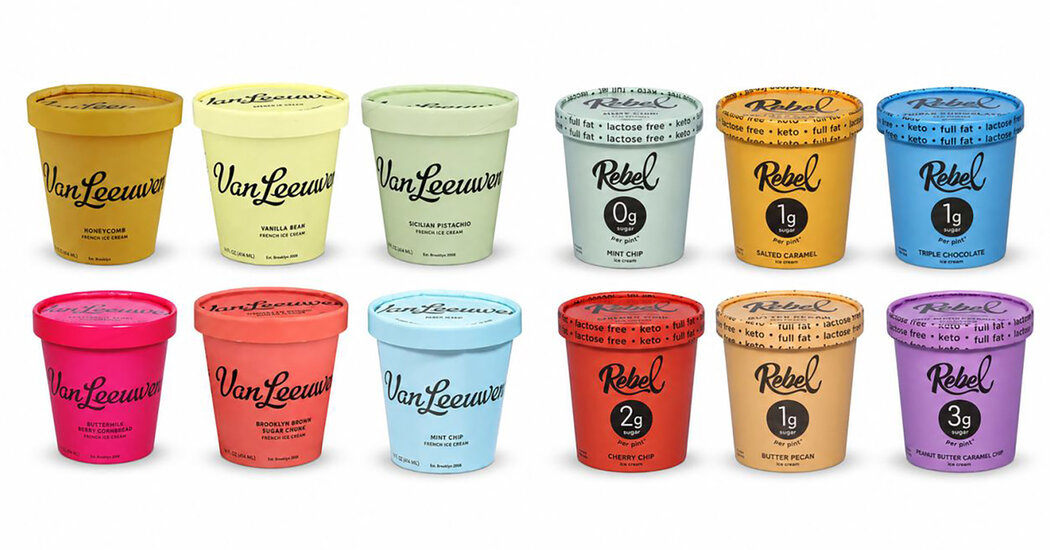

In the yearslong feud, supermarket freezer shelves were the initial front. Then, federal court.
On one side: Van Leeuwen Ice Cream, the Brooklyn-based artisanal scoop shop chain and grocery store staple. On the other: Rebel Creamery, the Utah company known for its keto-friendly, low carb ice cream.
Both feature pastel-colored pint containers with a brand name in script lettering. Their flavors — including mint chocolate chip, cookies and cream and pistachio — are printed in what appear to be similar typefaces.
The resemblance was so striking to Van Leeuwen that it accused Rebel in a lawsuit in 2021 of copying its distinctive packaging, winning a $24 million judgment in July against its rival in the Eastern District of New York.
Now, less than a month later, Rebel has filed for bankruptcy protection in Utah, casting uncertainty over the resolution of that judgment, which also bars the company from continuing to use its current packaging.
The case involves what is known as a trade dress, a concept similar to a trademark that applies to the packaging and design of products.
In a filing on Friday in U.S. Bankruptcy Court in Utah, Rebel declared that its estimated assets of nearly $14 million were not enough to cover the liabilities it had incurred from the lawsuit.
“We are appealing the decision, and our products will continue to be widely available,” Rebel said in statement on Tuesday.
In a decision in July, Judge Eric R. Komitee of the U.S. District Court in Brooklyn wrote that Austin and Courtney Archibald, the married couple who founded Rebel, had acted in bad faith in the design of the company’s containers.
In July 2018, two years after Van Leeuwen introduced its current packaging, a buyer for the grocery store chain Wegmans pointed out to Mr. Archibald that Rebel’s pint containers were similar to those sold by Van Leeuwen, Judge Komitee noted in his decision. The packaging, he added, had created confusion for supermarket employees and shoppers, but the company stuck with it.
“Rebel itself received a report from a confused consumer in August 2024,” Judge Komitee said. “She wrote that her husband purchased Rebel ‘by accident when I sent him to the store for Van Leeuwen,’ because ‘your product was placed right next to Van Leeuwen and looked the same.’ ”
The Archibalds, who used a Kickstarter crowdsourcing campaign to help raise money for their business venture, had denied copying Van Leeuwen’s packaging. But that did not persuade the judge.
“The likelihood of all these design features converging at random is infinitesimal,” Judge Komitee wrote.
In a statement on Tuesday, a Van Leeuwen representative said Rebel’s response to complaints about its packaging was one of defiance.
“Rebel had every opportunity, during five years of litigation, to cease using the infringing packaging, to acknowledge the confusion and harm it caused, or to resolve things with Van Leeuwen,” the statement said. “Rebel chose instead to continue profiting from its infringement and harming Van Leeuwen on competitive grocery store shelves.”
Mark P. McKenna, a law professor at the University of California, Los Angeles, and an expert in trademark law, said in an interview that Van Leeuwen’s lawsuit was somewhat unusual because its trade dress claims involved an entire line of ice cream packaging instead of an individual product.
“You wonder, does that mean no one else gets to use pastel colors for ice cream at all?” he said.
But Professor McKenna said photos of Van Leeuwen and Rebel ice cream containers side-by-side in supermarket freezers supported Van Leeuwen’s argument.
“You kind of see where they’re coming from,” he said.