
What did pending home sales look like in June?
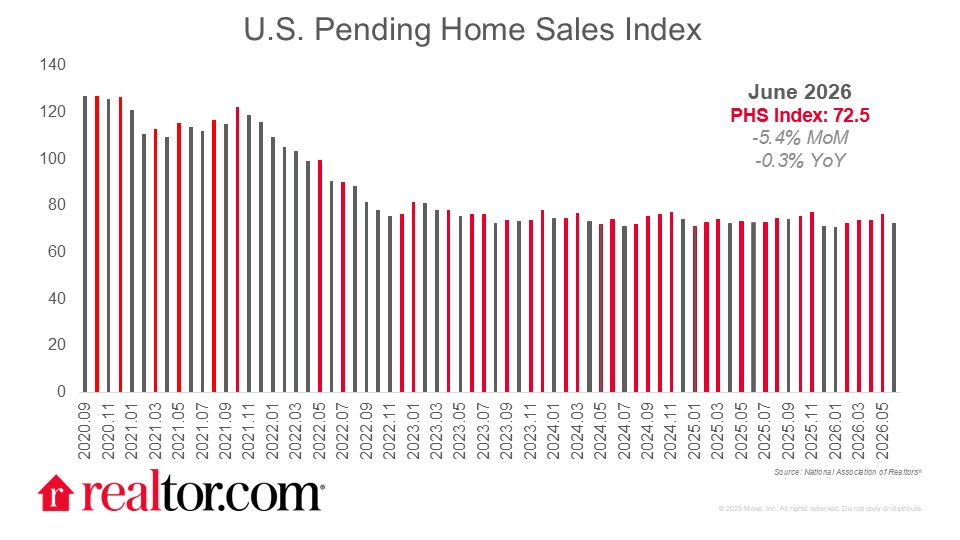
Pending home sales fell 5.4% in June as the steady spring market pulled back heading into summer. Contract signings were down 0.3% year over year as mortgage rates hovered around 6.5% through the month. Rates generally eased through June as tensions in the Middle East appeared to move toward resolution, but remained elevated relative to earlier in the year. Nevertheless, rates remained below year-ago levels, giving buyers lower financing costs at the same time that still-rising inventory continued the market’s shift toward greater buyer-favorability.
What does this mean for buyers, sellers, and the housing market?
Looking ahead, the Realtor.com Midyear Forecast Update laid out revised expectations for the year: mortgage rate projections held steady at 6.3%, while forecasts for existing home sales, home prices, and inventory growth were all revised lower. We still expect these metrics to post year-over-year gains, but the first half of 2026 saw more tempered growth than anticipated, lowering expectations for the year as a whole. On the positive side, affordability should improve in 2026, with the typical monthly payment running 1.9% below last year’s level.
All four regions saw contract signings fall in June. The Midwest saw the biggest dip of 8.9%, followed by the West (-4.7%), the South (-4.1%) and the Northeast (-3.0%). On an annual basis, the Northeast posted the strongest growth (+2.2%), followed by the Midwest (+0.3%), while the South (-0.9%), and the West (-1.1%) saw pending sales fall year-over-year.
Metro-level data, provided by Realtor.com, showed that Virginia Beach (+15.4%), Sacramento (+15.2%), and Kansas City (+14.4%) led all major markets in year-over-year pending sales growth. Austin, Texas also cracked the top 10, posting an 11.1% annual gain — a notable shift likely due to ample inventory and softening prices.
Pending home sales, or contract signings between buyers and sellers, mark the first formal step in the homebuying process and typically lead closings by one to two months, making them a useful gauge of near-term activity. The slight uptick in May translated into existing home sales climbing in June for the third consecutive month.
Looking ahead, the summer market is poised to remain steadily positive, though quieter than a typical pre-pandemic summer. Notably, June inflation data showed softening price growth, with headline inflation falling to 3.5% and core inflation easing to 2.6%. That softness could open the door to lower mortgage rates, offering some added fuel to the summer housing market.